

Expertly Taught First Aid Courses in the UK
First aid knowledge is vital for everyone, regardless of whether they’re on a construction site, in an office, or at home. Our first aid courses cover a range of topics, designed to give you the knowledge you need in a medical emergency.
From advanced to paediatric first aid, we’ve got the course you need to boost your knowledge. Get in touch today and learn more about our UK first aid training.
Gain Your Lifesaving First Aid Certificate
A colleague passes out in the office. A coworker’s hand is crushed by machinery. A member of the public suddenly falls down, clutching their chest. What would you do?
With our first aid courses, you’ll have the answers. You’ll learn everything from bandaging wounds to CPR, giving you the skills to act while you wait for professional help.
And at the end of your 1st aid training, you’ll receive your first aid certificate – proof that you’ve got the knowledge needed to save lives.
First Aid Classes: Essential Training
First aid training is the most important training you’ll ever do. The presence of a first aider on site can be the difference between life and death. Here are a few reasons why you should consider one of our certified first aid courses:
- Save Lives: Is there anything more important than saving lives? Our UK training lets you be the difference in a crisis.
- Legal Compliance: Many workplaces must have staff with a first aid qualification on-site to comply with the law. Failure to comply risks both lives and steep fines.
- Develop Skills: First aid training offer significant personal development, helping you build confidence and take on greater responsibility in the workplace.
Our First Aid Courses
Take a look below to see the variety of first aid courses available. Experts in their respective fields teach all our training.
They take place at our modern training centre and in venues throughout the country. We also offer some onsite first aid training – get in touch to learn more.







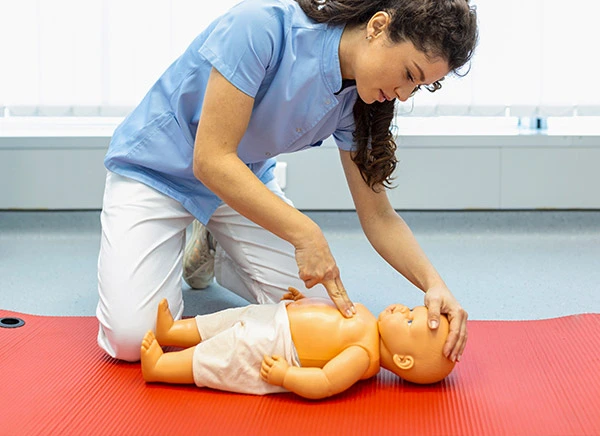
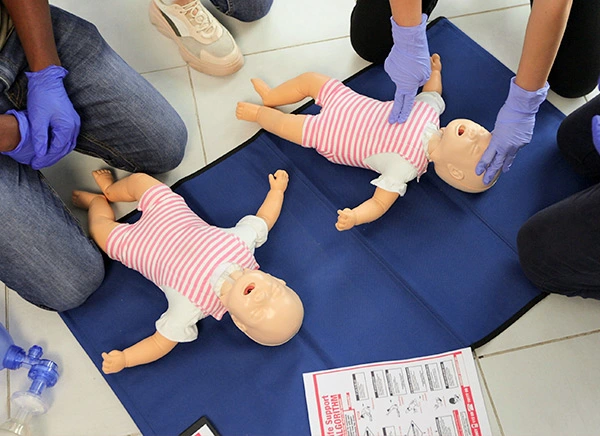


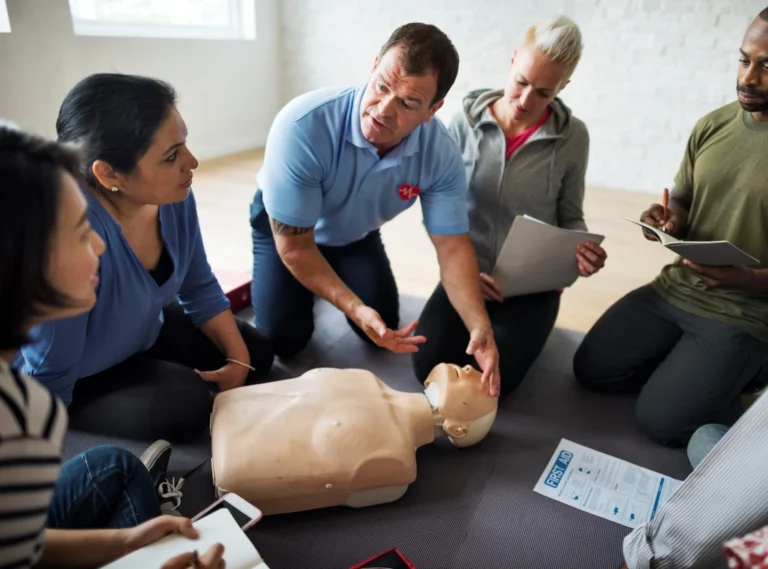


Courses – comparison
Side-by-side overview of durations, audiences, key topics, certificate validity and delivery formats.
| Course | Duration | Who it’s for | Key content | Certificate | Format |
|---|---|---|---|---|---|
| CourseFirst Aid at Work (FAW) | Duration3 days | Who it’s forSupervisors, site/warehouse leads; higher-risk workplaces | Key content
|
CertificateValid 3 years | FormatClassroom |
| CourseEmergency 1st Aid at Work (EFAW) | Duration1 day | Who it’s forLow- to medium-risk workplaces | Key content
|
CertificateTypically 3 years | FormatClassroom / Blended |
| CourseFirst Aid at Work Requalification | Duration2 days | Who it’s forHolders of in-date (or very recently expired) FAW | Key content
|
CertificateValid 3 years | FormatClassroom |
| CourseAnnual Skills (Refresher) | Duration1 day | Who it’s forExisting first aiders; yearly skills update | Key content
|
CertificateRefresher (annual) | FormatClassroom / Blended |
| Course1st aid course for Appointed Persons | DurationHalf-day | Who it’s forLow-hazard workplaces; nominated persons | Key content
|
CertificateProvider certificate | FormatClassroom / Live online |
| CoursePaediatric First aid training | Duration6 hrs (basic) or 12 hrs | Who it’s forNursery staff, childminders, parents | Key content
|
CertificateValid 3 years (Ofsted/EYFS) | FormatClassroom / Blended |
| CoursePaediatric course (2 days in 2 weeks) | Duration2 non-consecutive days (≤14 days) | Who it’s forEYFS/Ofsted-aligned roles; busy schedules | Key content
|
CertificateValid 3 years | FormatClassroom / Live online |
| CourseBlended Paediatric First Aid | DurationSelf-paced online + 1 day F2F | Who it’s forChildcare staff needing 12-hour credit | Key content
|
CertificateValid 3 years (EYFS) | FormatBlended |
| Course1st aid training for Baby & Child (Day) | Duration1 day (09:30–16:30) | Who it’s forParents, guardians, babysitters | Key content
|
CertificateValid 3 years | FormatClassroom / Blended |
| CourseFirst Aid for Baby & Child (Evenings) | DurationOne evening (~2.5–3 hrs) | Who it’s forParents/carers needing a short session | Key content
|
CertificateProvider certificate | FormatEvening (in-person) |
| CourseAED Training (Defibrillator & CPR) | Duration~2.5 hrs | Who it’s forAnyone (16+) incl. workplaces, schools, gyms | Key content
|
CertificateTypically 3 years | FormatIn-person / Live online |
| CourseFire Marshal Training | DurationHalf-day (~4 hrs) | Who it’s forDesignated fire marshals/wardens | Key content
|
CertificateProvider certificate | FormatIn-person |
Our First Aid Courses Compared
Wondering which of our first aid courses you should take? Look below to see how each course compares.
What Will You Learn?
All our courses are different. However, some of the skills you could learn while learning with us include:
• CPR: Learn how to save lives in the most high-pressure situations by learning CPR and other lifesaving skills.
• Accident Basics: Provide treatment for common injuries such as burns, sprains, and cuts.
• Mental Health: Spot those with signs of mental health problems and learn how to offer the support they need.
• Up-to-Date Information: First aid techniques and theories are constantly evolving. Stay up-to-date with our regular 1st aid refresher courses.
You’ll also find we have first aid courses that focus on specific areas, such as first aid at work courses and for appointed persons. Not sure which is best for you? Get in touch today, and we’ll walk you through your options.

Be Prepared with Certified First Aid Training
We’re a top first aid training provider, with the experience needed to deliver high-quality training to a variety of learners.
Whatever your reasons for learning first aid, we’re here to guide you through the process, ensuring you’ve got the knowledge needed to save lives in emergencies.
To learn more about our first aid courses, call us today on 01234 604 151 or email us via office@cpts.uk. We’re looking forward to hearing from you.
Choose our first aid courses near You!
If you have not found the 1st aid training you were looking for please contact us. We will be happy to help
Find First Aid courses near You in the UK - Details:
Which First Aid course does your workplace actually need?
Choosing First Aid training is not simply a matter of picking the shortest course or sending one person from the team on a convenient date. A small office, a busy warehouse and an active construction site may have completely different first aid requirements. The sensible starting point is therefore the workplace itself.
For employers in Great Britain, the Health and Safety Executive expects first aid provision to be adequate and appropriate for the circumstances identified through a first aid needs assessment. That assessment should influence the number of people you train, the type of course they complete, the equipment you provide and where that equipment is located.
That makes a practical difference. Five workers carrying out higher hazard construction activities can present a very different first aid challenge from five people working at desks. Headcount matters, but it is only part of the picture.
Start with a First Aid needs assessment
What could realistically happen at your workplace? How quickly could somebody reach an injured person? Would the same arrangements work at 7am, during a night shift and when the usual first aider is on holiday? These questions are far more useful than choosing a qualification by name alone.
A good first aid needs assessment should consider the real working environment rather than an ideal version of it. HSE guidance tells employers to look beyond employee numbers and consider hazards, accident history, working patterns, the physical layout of the premises and access to professional emergency help.
- Consider the hazards and risks created by the work itself. Machinery, sharp equipment, work at height, vehicles, electricity, hazardous substances and other activities can change the injuries a first aider may need to manage.
- Look at how many people are actually present during each working period. A daytime headcount tells you very little if part of your operation also runs evenings, nights or weekends.
- Review previous accidents, incidents and patterns of ill health. What has already happened can reveal whether your existing provision matches the problems people genuinely face.
- Take account of lone, mobile and remote workers. A first aid box in the main office will not solve much when somebody is working alone elsewhere.
- Think about distance and access to emergency medical services. Large sites, remote projects and difficult access routes can all affect the response plan.
- Include planned and unexpected absence. Annual leave, sickness and changing shifts should not leave the workplace without the provision identified as necessary.
- Consider visitors, contractors and members of the public. HSE strongly recommends including non employees when assessing first aid arrangements even though the First Aid Regulations do not impose the same duty towards them.
- Consider employees with particular physical or mental health needs. HSE guidance now expressly reminds employers to include mental health when reviewing first aid needs.
One important distinction. A risk assessment is used to identify and control workplace health and safety risks. A first aid needs assessment then asks what provision will be required if somebody is injured or becomes ill despite those controls.
How many First Aiders might a workplace need?
There is no single statutory ratio that works for every business. HSE nevertheless provides a useful decision framework in Appendix 3 of its First Aid at Work guidance. It separates lower hazard and higher hazard workplaces and then considers employee numbers.
| Workplace profile | People employed | HSE suggested starting point |
|---|---|---|
| Lower hazard Examples include offices, shops and libraries |
Fewer than 25 | At least one appointed person |
| Lower hazard | 25 to 50 | At least one EFAW trained first aider |
| Lower hazard | More than 50 | At least one FAW trained first aider for every 100 employees or part thereof |
| Higher hazard HSE examples include construction, warehousing and extensive work with dangerous machinery or sharp instruments |
Fewer than 5 | At least one appointed person |
| Higher hazard | 5 to 50 | At least one EFAW or FAW trained first aider depending on the type of injuries that may occur |
| Higher hazard | More than 50 | At least one FAW trained first aider for every 50 employees or part thereof |
These figures are guidance rather than automatic legal minimums for every workplace. Your assessment may identify the need for more first aiders, additional equipment or additional training. Shift patterns, multiple floors, large compounds, remote work and first aider absence can all alter the answer.
Not sure whether your team needs EFAW, FAW or something more specific?
Tell us about your workplace, the work your employees carry out and the number of people you need to train. We can discuss the available First Aid courses and help you identify the most appropriate training option for your requirements.
First Aid on a construction site needs a closer look
A construction site changes from week to week. Excavations appear and disappear. Plant arrives. Subcontractors move in. Access routes change. One phase may involve relatively straightforward groundworks while another introduces lifting operations, confined spaces or extensive work at height.
This is exactly why a construction business should not treat First Aid provision as a document that gets completed once and forgotten. Review it when the workforce, activities, layout or foreseeable injuries change.
Life threatening bleeding
HSE specifically identifies construction as one of the sectors where a needs assessment may indicate additional training in the management of life threatening bleeding. This can include haemostatic dressings, wound packing or tourniquets where the identified risks justify it.
Changing access
An ambulance reaching the site entrance is not the same thing as reaching the casualty. Consider gates, temporary routes, tower levels, compounds and restricted areas when planning how professional help will reach somebody quickly.
Multiple work areas
A large development can make one central first aid point impractical. HSE recommends considering provision in separate buildings, floors or work areas where the premises are spread out.
Shift and absence cover
The arrangement has to work whenever people are at work. Do not build the entire plan around one trained person who may be on another project, on leave or unavailable when an incident occurs.
Several employers on one site
Construction projects frequently involve more than one employer. HSE recommends arrangements between site occupiers so adequate provision is maintained and strongly recommends documenting shared arrangements in writing.
Remote and lone work
People who travel, work alone or work away from the main site may need different arrangements. Personal First Aid kits and reliable communication can form part of the response where the needs assessment identifies that requirement.
Extra equipment only makes sense when people know how and when to use it. Specialist items identified by a site assessment should be supported by suitable training and incorporated into the emergency arrangements rather than simply placed in a First Aid kit.
What should modern First Aid training reflect in 2026?
First Aid is practical training. Somebody may understand a presentation perfectly and still struggle when the situation suddenly becomes real. This is why current standards, practical assessment and repeated practice matter.
The Health and Safety Executive states that FAW and EFAW training should follow currently accepted first aid practice, including current guidance from the Resuscitation Council UK. The organisation published its latest UK resuscitation guidelines in 2025.
CPR practice has measurable standards
Current Resuscitation Council UK adult basic life support guidance recommends chest compressions at 100 to 120 per minute and a depth of at least 5 cm but no more than 6 cm for adults.
If a person is unresponsive with abnormal breathing, the guidance says to presume cardiac arrest and start the emergency response without unnecessary delay.
An AED is designed to be used when it is needed
Resuscitation Council UK states that anyone can use an Automated External Defibrillator. Training remains valuable because practice helps people recognise the situation, retrieve the device and act with less hesitation.
In a real emergency, follow the instructions from the emergency call handler and the prompts given by the AED.
For an employer, the practical question is therefore not merely whether a course has the right title. Ask whether learners actually demonstrate competence, whether practical elements are directly assessed and whether teaching follows current accepted UK first aid practice.
How can you check a First Aid training provider?
There is an important detail that is surprisingly easy to miss. HSE no longer approves individual First Aid training providers or First Aid qualifications in Great Britain. The approval requirement was removed in 2013. Employers therefore have responsibility for selecting a competent provider and, where necessary, carrying out appropriate due diligence.
So what should you look for before booking?
- The trainers and assessors should be appropriately qualified and competent.
- The organisation should have suitable quality assurance arrangements.
- The syllabus should meet the required content and duration for the qualification being delivered.
- FAW and EFAW content should follow currently accepted First Aid practice.
- Practical competence should be properly assessed. HSE strongly recommends direct observation of practical elements.
- Blended learning needs proper controls. HSE accepts a mix of elearning and face to face training for workplace First Aid where appropriate, but sufficient classroom time and practical assessment still have to be provided.
- The certificate should contain the information expected for the qualification. For FAW and EFAW this includes the candidate, training organisation, qualification, commencement date and three year validity.
This is a much better way to assess training than looking for an outdated statement that a provider is simply “HSE approved”.
Need First Aid training for several employees?
Training requirements often become easier to organise when you look at the whole team rather than individual bookings. Tell us how many people need training, where they work and what type of workplace you operate. We can discuss suitable course options, available dates and group training arrangements.
What happens when a First Aid certificate is getting older?
Passing a course is not the end of the story. Skills such as CPR are rarely used during an ordinary working day, which is exactly why they can become less familiar over time.
After qualification
FAW and EFAW certificates used for workplace First Aid are normally valid for three years. Employers should keep track of certification dates so expiry does not create an unexpected gap in cover.
During the three year period
HSE strongly recommends annual refresher training for qualified First Aiders. It is a recommendation rather than a mandatory requirement, but it helps people maintain basic practical skills and keep up with changes in procedure.
Before the certificate expires
Plan requalification before the expiry date rather than waiting until the workplace is left without the trained personnel identified by the needs assessment.
If an FAW certificate has already expired
HSE guidance allows FAW requalification after expiry, but says that when a considerable period has elapsed, with more than one month given as an example, it may be prudent to complete the full FAW course again. The employer is responsible for deciding what is appropriate in the circumstances.
Existing First Aiders can find further details about our First Aid Refresher Course and First Aid at Work Requalification course.
Paediatric First Aid and the current EYFS requirements
Paediatric First Aid needs to be considered separately from ordinary workplace First Aid. This is particularly important for nurseries, early years settings, childminders and schools because the statutory Early Years Foundation Stage framework sets specific requirements in England.
The current EYFS frameworks took effect on 1 September 2026. For group and school based early years providers, at least one person holding a current certificate from a full Paediatric First Aid course consistent with Annex A must be on the premises and available whenever children are present. A person meeting that requirement must also accompany children on outings.
Emergency Paediatric First Aid
The current EYFS Annex A states that an emergency PFA course should be delivered face to face and last for a minimum of 6 hours excluding breaks.
Full Paediatric First Aid
The full PFA course should last for a minimum of 12 hours excluding breaks. The emergency PFA elements included within the full course should be delivered face to face.
Paediatric First Aid certification under the EYFS must be renewed every three years. The framework also requires suitable equipment to allow trainees to practise and demonstrate techniques with baby and junior models.
The EYFS requirements described here apply to England. Childcare providers operating elsewhere in the United Kingdom should check the framework and regulator applicable in their own jurisdiction.
For relevant options on this website, see our Paediatric First Aid Course and Blended Paediatric First Aid Course. Before booking training for professional childcare purposes, confirm that the chosen delivery format meets the statutory requirements applying to your role and setting.
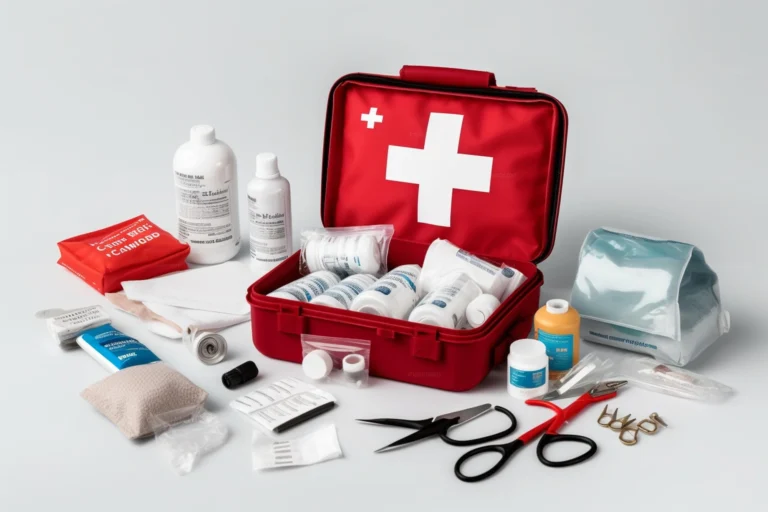
Does every First Aid kit need the same contents?
No. This is another area where a simple universal shopping list can be misleading.
HSE states that there is no mandatory list of items that every workplace First Aid container must contain. What you provide should reflect the findings of the first aid needs assessment. A low hazard office and a construction project involving sharp equipment or remote working may reasonably need different provision.
The practical questions are straightforward. Is the equipment suitable for the injuries you have identified? Is there enough of it? Can people reach it quickly? Is somebody checking stock, packaging and expiry dates? Does the arrangement still work in another part of the site?
If the assessment identifies a specialist hazard, avoid assuming that buying specialist equipment solves the problem on its own. Training, competence, location and the wider emergency procedure matter just as much.
Great Britain and Northern Ireland do not use exactly the same legislation
A UK wide training page should make this distinction clear. England, Scotland and Wales use the Health and Safety First Aid Regulations 1981 and HSE guidance. Northern Ireland has separate Health and Safety First Aid Regulations Northern Ireland 1982, administered by the Health and Safety Executive for Northern Ireland.
The systems are nevertheless closely aligned. HSENI confirms that employers in Northern Ireland also need appropriate First Aid arrangements and that FAW and EFAW remain central workplace First Aid qualifications.
Build First Aid into the rest of your site safety training
First Aid prepares people to respond when something has already gone wrong. It should therefore sit alongside training that helps prevent incidents in the first place. For construction businesses in particular, the most useful training plan is usually the one that reflects the actual activities performed by the workforce.
You can also browse our complete construction training course range if you are planning training for several roles or activities.
Want to organise First Aid training without guessing which course to choose?
Speak to our team about your workforce, workplace and training requirements. We can help you compare the available First Aid courses and discuss individual, group and on site training options.
FAQ – First Aid training
Do you have a question about our first aid courses? Below you will find practical answers about workplace First Aid training, FAW, EFAW, certificates, construction site requirements and course delivery.
Are your courses suitable for me?
Yes, you don’t need any previous experience to take part in our 1st aid training. You just need to be over 16 and serious about learning.
Do I need first aid training?
Everyone can benefit from understanding first aid, but workplace requirements depend on the employer’s first aid needs assessment. Employers in Great Britain must provide adequate and appropriate first aid equipment, facilities and personnel. Depending on the workplace, this may mean an appointed person, an EFAW trained first aider, an FAW trained first aider or additional training for specific risks.
What is the difference between First Aid at Work and Emergency First Aid at Work?
Emergency First Aid at Work, usually shortened to EFAW, prepares a first aider to provide emergency first aid when someone is injured or becomes ill at work. First Aid at Work, usually shortened to FAW, includes the EFAW syllabus and covers a wider range of specific injuries and illnesses. The appropriate level should be selected from the findings of the employer’s first aid needs assessment.
How do I know which First Aid course my workplace needs?
Start with a first aid needs assessment. Consider the hazards and risks in the workplace, the number of employees, the size and location of the site, work activities, shift patterns, lone or remote working, previous incidents and how quickly professional medical help can be reached. The assessment should then determine whether you need an appointed person, EFAW, FAW or additional training.
How many First Aiders does my workplace need?
There is no single statutory number that applies to every workplace. HSE says the number of trained first aiders should be based on the findings of the first aid needs assessment and the circumstances of the workplace. Factors such as higher hazard work, employee numbers, separate work areas, shifts, holidays, sickness and remote locations can all affect how many trained people are required.
What is an appointed person and do they need First Aid training?
An appointed person takes charge of first aid arrangements when the first aid needs assessment identifies that a trained first aider is not required. Their role includes looking after first aid equipment and facilities and calling the emergency services when necessary. HSE does not require an appointed person to have formal first aid training, although they should not provide first aid for which they have not been trained.
How long is a First Aid at Work certificate valid?
First aid training certificates used for workplace first aid purposes, including FAW and EFAW certificates, are valid for three years. Employers should monitor certificate dates and arrange appropriate retraining or requalification before certificates expire.
Do First Aiders need annual refresher training?
Annual refresher training is not a mandatory requirement during the three year FAW or EFAW certification period, but HSE strongly recommends it. Regular refresher training helps qualified first aiders maintain practical skills and keep up to date with changes in first aid procedures.
What happens if my First Aid certificate expires?
Once a workplace first aid certificate has expired, the person is no longer considered competent to act as a workplace first aider for the purposes of the HSE guidance. FAW holders can requalify after expiry, but HSE states that completing the full FAW course may be prudent where a considerable period has passed, with more than one month given as an example. The employer should decide which requalification route is appropriate.
Is First Aid training mandatory for construction workers?
There is no general rule requiring every construction worker to personally hold an FAW or EFAW certificate. Employers must provide adequate and appropriate first aid arrangements, and construction is treated as a higher hazard environment when assessing provision. The number and level of trained first aiders should therefore reflect the workforce, activities, foreseeable injuries, site layout and other findings of the first aid needs assessment.
Can First Aid at Work training be completed online?
HSE accepts blended learning for workplace first aid training, combining e-learning with face to face teaching. Employers should check that enough time is allocated to classroom based learning and practical assessment, and HSE strongly recommends direct observation of practical elements. A course described as fully online should not automatically be assumed to meet the requirements expected for workplace FAW or EFAW competence.
Does HSE approve First Aid training providers?
For ordinary workplace FAW and EFAW training in Great Britain, HSE no longer approves first aid training providers or qualifications. This changed on 1 October 2013. Employers are responsible for selecting a competent provider and carrying out appropriate due diligence. HSE approval still exists for certain specialist offshore first aid and medic training.
Do you offer a first aid class near me?
We conduct our courses at our training centre in Wellingborough, Northamptonshire. We also offer training at selected venues and can arrange on site first aid training for teams. Contact us with your location and the number of learners and we can discuss the available options.
What are your first aid courses prices?
First aid prices vary from course to course. The final cost depends on the training selected and, where applicable, the delivery arrangements. Contact us for the current price of the course you need and to discuss group or on site training.
How long are courses?
This depends on the course you choose. Emergency First Aid at Work training and assessment should be at least six hours, excluding breaks, over a minimum of one day. First Aid at Work training and assessment should be at least 18 hours, excluding breaks, over a minimum of three days. Other courses, including refresher and paediatric training, have different durations.
UK guidance used when planning First Aid provision
Health and Safety Executive. HSE is Great Britain’s national regulator for workplace health and safety. Its First Aid at Work guidance explains employer duties, needs assessments, FAW and EFAW provision, First Aid personnel and training provider selection. Read HSE First Aid guidance.
Resuscitation Council UK. The organisation produces evidence based UK resuscitation guidelines used to inform current CPR and AED practice. Read the current Adult Basic Life Support Guidelines.
Department for Education. The statutory EYFS framework defines safeguarding and welfare requirements for early years providers in England, including Paediatric First Aid requirements. Read the current EYFS framework.
Health and Safety Executive for Northern Ireland. HSENI administers the separate workplace First Aid legislation applying in Northern Ireland. Read HSENI First Aid at Work guidance.