
For Companies: pay only 30% with CITB Employer Network Funding
Enquire nowCambridge can look calm from the outside. Inside its workplaces, the picture is far more complex. A scientist may be working with specialist materials in a laboratory. A contractor may be moving equipment on a construction project. A college employee may be responsible for students and visitors. A market trader may suddenly face a customer who collapses. A facilities team on the Biomedical Campus may work in a completely different environment from an office a few streets away.
That is why First Aid training in Cambridge should never begin with one question. Which course is cheapest? A much better question is simple. What could realistically happen here, and who would be expected to respond first?
Our First Aid courses for Cambridge are suitable for individuals, employers, supervisors, facilities teams, construction workers, education staff, childcare professionals, customer facing businesses and organisations that need practical emergency skills rather than a certificate that sits unnoticed in a folder.
The right First Aid course should fit the environment, not the other way around. For some workplaces that means Emergency First Aid at Work. Others may need the broader First Aid at Work qualification, paediatric training, annual refresher training, requalification or additional competence identified through the employer’s First Aid needs assessment.
Looking for First Aid training in Cambridge? Call CPTS on 01234 604 151 or email office@cpts.uk. Tell us what your workplace does, how many people need training and what sort of risks are present. We can help you compare the available First Aid courses and delivery options.
Cambridge is unusual because research, healthcare, higher education, tourism, hospitality, retail, construction and technology operate almost on top of one another. That mixture matters when you plan First Aid.
Cambridge Biomedical Campus is the largest employment site in the city. More than 22,000 people work there and more than 37,000 people visit the Campus each day. It brings together biomedical research, patient care, education, industry, facilities management, hospitality, construction and logistics on one site.
The University of Cambridge adds another layer. A University commissioned economic study published in 2023 estimated that its activities support more than 52,000 jobs in the East of England. The city centre then adds colleges, shops, restaurants, events, visitors and a market network supported by Cambridge City Council, which says it works with around 200 independent traders in the centre.
Put those environments together and a generic First Aid plan starts to look rather thin. The people, hazards, premises and response times can change dramatically from one part of Cambridge to another.
The Health and Safety Executive requires employers in Great Britain to provide adequate and appropriate First Aid equipment, facilities and personnel. It does not give every business the same fixed number of first aiders. The employer has to assess what is actually needed.
This matters in Cambridge because a single organisation can occupy several buildings, run laboratories and offices, host visitors, use contractors and operate outside ordinary office hours. Headcount alone does not tell you whether someone can reach a casualty quickly enough.
One useful way to think about it. Your general risk assessment asks how to prevent harm. Your First Aid needs assessment asks what must be ready if somebody is still injured or becomes ill despite those controls.
Cambridge Biomedical Campus is a particularly good example of why First Aid planning has to follow the workplace. It combines research organisations, three NHS hospitals, the University of Cambridge School of Clinical Medicine, industry and support services. The Campus states that its community also includes careers in healthcare, construction, hospitality, life sciences, facilities management and logistics.
That means two people working on the same Campus can have completely different First Aid needs. A laboratory technician, a catering employee, a construction contractor and an office based administrator should not be treated as if the same hazards surround them.
This is an easy assumption to make in Cambridge. Addenbrooke’s, the Rosie and Royal Papworth are on the Biomedical Campus, so surely professional medical care is already close by? Close does not mean immediate.
Employers still need adequate and appropriate workplace First Aid arrangements. Proximity to emergency medical help can form part of the needs assessment, but somebody may still need immediate assistance before professional care reaches the exact room, floor, laboratory or work area where the incident occurred.
A standard FAW or EFAW course is designed around workplace First Aid. It cannot replace specialist emergency procedures for every laboratory hazard. Where work involves specific substances, biological materials or specialist processes, the employer should include those hazards in the First Aid needs assessment and decide whether additional training, equipment or procedures are required.
This distinction is important. Buying a specialist item and putting it in a cupboard does not create competence. The people expected to use additional equipment need suitable instruction and the emergency plan has to connect with the wider workplace procedures.
Instead of starting with every course name, work through the decision in stages. It is usually much easier.
View Emergency First Aid at Work training
View First Aid at Work training
View First Aid at Work Requalification
View the First Aid Annual Skills Course
View First Aid Appointed Person Training
View Paediatric First Aid training
Still unsure which First Aid course your Cambridge organisation needs? Call 01234 604 151 or email office@cpts.uk. Describe the workplace, the role of the learner and the number of people you need to train. We can help you compare the available options before you book.
Resuscitation Council UK published new national guidelines in October 2025. The principles of CPR remain familiar, but there is a useful change in the sequence for an unresponsive person.
The 2025 guidance says to call 999 as soon as possible when a person is unresponsive. You can then assess breathing while waiting for the call to be answered, with support from the ambulance service call handler if needed.
If the person is unresponsive and not breathing normally, cardiac arrest should be assumed and chest compressions should begin without unnecessary delay. Current adult guidance recommends a rate of 100 to 120 compressions per minute and a depth of at least 5 cm but no more than 6 cm.
Resuscitation Council UK also states that anyone can use an Automated External Defibrillator. The device gives visual and audio prompts. Training remains valuable because people act more calmly when they have already practised the sequence.
The 2025 RCUK guidance specifically says locations with high population flow, such as shopping centres, airports and railway stations, should have readily accessible on site AEDs. In a city built around major visitor flows, universities, public transport, research campuses and a busy centre, familiarity with AED response can be particularly useful.
Cambridge is globally associated with education, but a university or college is not just a lecture room. It can include kitchens, libraries, laboratories, workshops, accommodation, grounds teams, events, offices and historic buildings used by staff, students and visitors.
That mixture changes First Aid planning. A small departmental office may need one arrangement while a college running public events, catering and maintenance functions may need something broader.
The physical layout matters as much as the number of people. A trained first aider in another building, another courtyard or another part of a large site may not be immediately available when a casualty needs help.
Where an organisation operates several buildings, employers should consider whether First Aid personnel and equipment are distributed sensibly. The plan should also survive annual leave, sickness, evening events and periods when staff numbers change.
Cambridge city centre has to serve local residents, students and a large visitor economy at the same time. Cambridge City Council describes the centre as a magnet for tourism and supports around 200 independent market traders.
Market Square itself trades seven days a week. In September 2026, planning permission was granted for improvements to the Market Square and surrounding public realm as part of the Cambridge Civic Quarter project. That means retail, events, visitors and construction activity can overlap in a very compact part of the city.
For customer facing businesses, the practical question is not only whether an employee could become ill. What happens if a customer collapses? What if somebody chokes in a cafe? What if an incident happens outside the normal staff area?
HSE strongly recommends including visitors and members of the public when considering First Aid provision. For busy shops, hospitality businesses, markets and venues, that can affect the number and location of trained people, equipment and emergency procedures.
Cambridge continues to invest in research facilities, transport, public spaces, housing and commercial development. The Biomedical Campus itself reports significant ongoing construction activity, while the city centre is progressing the Civic Quarter programme.
Construction is one of the higher hazard workplace examples used in HSE First Aid guidance. The course choice still depends on the actual site, but the foreseeable injuries can be more serious than in a typical office.
HSE updated its L74 guidance in 2024 to give more attention to life threatening bleeding. Construction is one of the sectors specifically mentioned where the employer may identify a need for additional competence.
Where the assessment justifies it, additional training can include haemostatic dressings, wound packing or tourniquets. Specialist equipment should never be treated as a substitute for training.
A site can look completely different after a few weeks. Hoardings move, gates change, floors open, temporary stairs appear and teams work in new zones. Emergency access should change with the project rather than remain frozen in the original plan.
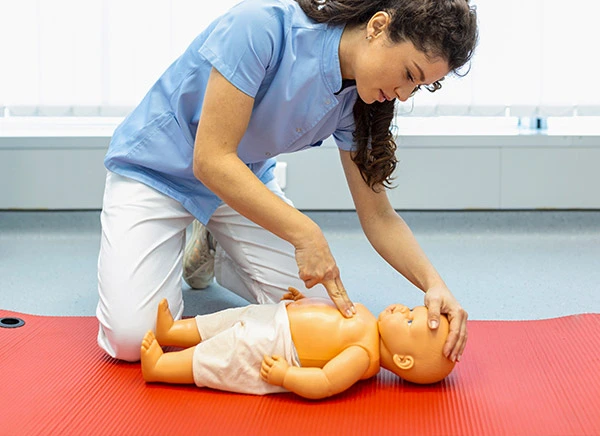
Childcare First Aid cannot simply be treated as a smaller version of adult workplace training. Babies and young children require different techniques and different emergency thinking.
The current Early Years Foundation Stage frameworks came into force on 1 September 2026 and apply to registered early years providers in England. They contain specific paediatric First Aid requirements.
Emergency paediatric First Aid should include a minimum of 6 hours face to face training. The full paediatric First Aid course should provide at least 12 hours of training excluding breaks, with the emergency elements delivered face to face. Certification must be renewed every three years.
Cambridge nurseries, childminders, schools and early years employers should match the course and delivery format to the statutory requirements that apply to the setting and role.
One employee can usually attend whichever date is convenient. A whole team brings rotas, project deadlines, laboratory schedules, teaching commitments, shifts and annual leave into the conversation.
The sensible approach is to calculate how much First Aid cover the workplace needs at any one time, then allow for the fact that real people take holidays, become ill and sometimes move to another role.
Training exactly the theoretical minimum number can create a fragile arrangement. A workplace needs cover that still works on an ordinary difficult day, not only when every name on the training matrix is present.
For suitable courses and groups, CPTS states that on site First Aid training can be arranged. That can reduce travel, simplify scheduling and allow colleagues to learn together in the context of a workplace they already understand.
Planning First Aid training for a Cambridge research organisation, college, contractor, nursery, office, hospitality business or customer facing team? Call 01234 604 151 or email office@cpts.uk. Tell us how many learners you have and what they do, and we can discuss suitable course and group training options.
There is one outdated phrase that still appears surprisingly often. HSE approved First Aid provider. HSE stopped approving individual workplace First Aid training providers and qualifications in 2013.
The employer is responsible for choosing a competent provider. HSE due diligence guidance tells employers to look at trainer and assessor competence, course content, practical assessment, quality assurance and whether training reflects currently accepted First Aid practice.
Before you book, ask whether the provider can demonstrate the following.
Most people do not freeze in an emergency because they do not care. They freeze because several decisions arrive at once. Is the scene safe? Is the person conscious? Should I call 999 now? Are they breathing normally? Where is the AED? Who can help me?
Practical First Aid training turns those questions into an order of actions you have already rehearsed.
1. Notice danger first. A rescuer who becomes injured creates another casualty and delays the response.
2. Check whether the person is responsive. This helps you decide how urgently professional help is needed.
3. Call 999 promptly when someone is unresponsive. This reflects the 2025 Resuscitation Council UK guidance and brings the ambulance call handler into the response earlier.
4. Assess breathing and start CPR when required. Good compressions need practice, not just memorised numbers.
5. Use an AED as soon as it is available. The device gives prompts, but prior practice removes much of the hesitation.
6. Control serious bleeding. Direct action in the first minutes can matter while professional help is still travelling.
7. Monitor and hand over. The casualty can change, and emergency teams need clear information about what happened and what has already been done.
If you are planning training for several roles, these pages can help you compare the wider First Aid and site safety options available through CPTS.
These are some of the practical questions Cambridge employers and learners may need to answer before choosing First Aid training.
Yes. Employers in Great Britain must provide adequate and appropriate equipment, facilities and personnel so employees can receive immediate attention if they are injured or become ill at work. The exact provision should come from the employer’s First Aid needs assessment.
No. HSE does not impose one fixed arrangement on every workplace. A small lower risk workplace may only need an appointed person, while another workplace may need EFAW or FAW trained first aiders and additional provision. The needs assessment determines what is appropriate.
No. Employers still need adequate and appropriate workplace First Aid arrangements. The proximity of professional medical help can be considered in the needs assessment, but someone may still require immediate assistance before professional responders reach the exact location of the casualty.
They can. A laboratory may contain specific hazards that are not fully addressed by a standard workplace First Aid course. Employers should include those hazards in the needs assessment and decide whether additional training, equipment or specialist emergency procedures are required.
Emergency First Aid at Work focuses on immediate emergency response when someone becomes injured or ill at work. First Aid at Work includes the EFAW content and extends training to a wider range of injuries and illnesses. The employer’s assessment should guide the choice.
There is no universal number. The employer should consider hazards, workforce size, separate buildings, floors, working hours, absence, visitors and how quickly a trained person can reach a casualty. Large or distributed sites may require more cover than the headline employee number suggests.
HSE uses construction as an example of a higher hazard workplace in its general guidance. The exact training and number of first aiders still depend on the specific site, workforce and foreseeable injuries identified by the employer.
Yes, where the needs assessment identifies the risk. HSE specifically refers to construction when discussing additional training for life threatening bleeding, which can include haemostatic dressings, wound packing or tourniquets where appropriate.
One important change is that rescuers should call 999 as soon as possible when they find an unresponsive person, then assess breathing while waiting for the call to be answered. If the person is unresponsive and not breathing normally, cardiac arrest should be assumed and CPR started promptly.
Yes. Resuscitation Council UK states that anyone can use an Automated External Defibrillator. The device provides instructions. Training is still valuable because people who have practised the sequence are usually more confident about recognising cardiac arrest, retrieving the AED and acting quickly.
Workplace FAW and EFAW certificates are normally valid for three years. Employers should organise requalification before expiry so the workplace does not lose the level of First Aid cover identified as necessary.
HSE strongly recommends annual refresher training during the three year certification period. It is a recommendation rather than a statutory requirement, but it helps people maintain practical skills that they may rarely use in real emergencies.
Not every workplace First Aid qualification is suitable for online only delivery. HSE accepts blended learning where appropriate, but practical skills require suitable face to face teaching and assessment when the qualification calls for them.
Registered early years providers in England must follow the current EYFS framework. The framework includes specific paediatric First Aid requirements, including minimum course duration, face to face emergency elements and three year certificate renewal.
CPTS states that on site First Aid training is available for suitable groups and courses. Contact the team with the number of learners, the course you are considering and your Cambridge location so the available delivery options can be discussed.
The main CPTS First Aid page lists Cambridge among the cities served near its training network. Courses are delivered at the Northamptonshire training centre, at selected venues around the country and on site for suitable groups. Confirm the venue for your specific course and date before travelling.
No. HSE stopped approving individual workplace First Aid training providers and qualifications in 2013. Employers are responsible for choosing a competent provider and should consider trainer competence, course content, quality assurance and practical assessment.
Prices depend on the course, duration, number of learners and delivery arrangement. A one day EFAW course, a three day FAW course and private group training are different products. Contact CPTS for current dates and pricing.
Cambridge is a city where a research campus, a historic college, a construction site, a market stall and a technology office can all sit within a short journey of one another. The First Aid risks are not identical, so the training should not be chosen blindly.
Start with the place, the people and the situations they may genuinely face. Then choose the course that gives the right level of competence for that responsibility.
If you are arranging workplace training, use the First Aid needs assessment to guide the decision. If you already know the course you need, the next step is simply to check dates, location and the most practical delivery option for your learners.
Ready to arrange First Aid training in Cambridge? Call CPTS on 01234 604 151 or email office@cpts.uk to ask about current course dates, Cambridge availability, group bookings and the most suitable First Aid route for your requirements.
We appreciate your message and will respond as soon as possible.