
For Companies: pay only 30% with CITB Employer Network Funding
Enquire nowCorby has always been a town where people make things, move things and build things. Its industrial identity grew from ironstone and steel. Today that same working character can be seen in manufacturing, logistics, engineering, construction, warehousing, retail and a growing network of new communities. First Aid training in Corby therefore cannot be reduced to one standard course for every workplace.
A medical emergency in a quiet office is one thing. A serious cut beside production machinery, a collapse in a warehouse, a fall on a construction project or a child choking in an early years setting presents a very different situation. The correct training depends on the people, the hazards and the environment around them.
Our First Aid courses for Corby are designed to help individuals and employers choose training that matches real responsibilities. You can learn practical emergency skills, renew an existing workplace qualification, arrange training for a team or choose paediatric First Aid where your role involves babies and young children.
The aim is simple. When something suddenly goes wrong, you should not be trying to remember a page from a manual. You should have already practised what to do.
Looking for First Aid training in Corby? Call CPTS on 01234 604 151 or contact our team with your role, workplace type and number of learners. We can help you compare the available First Aid courses and discuss group training options.
Corby is not a generic local service area. Its economy has a distinctive industrial profile. North Northamptonshire Council describes the area as having a strong manufacturing and logistics base. Its current investment material states that manufacturing employs 14 per cent of the North Northamptonshire workforce and rises to more than 30 per cent in towns such as Corby.
That matters when we talk about First Aid. Manufacturing and logistics can involve moving vehicles, powered equipment, loading activity, sharp materials, manual handling, machinery and work spread across large premises. None of that automatically determines the course an employer needs, but it changes the questions that should be asked during a First Aid needs assessment.
Corby is changing as well. The council is progressing major development around the town. Magna Park on the outskirts of Corby covers around 80 hectares and the council has said the scheme is expected to employ more than 7,000 people. Priors Hall is a development of more than 5,100 homes, while Weldon Park includes around 1,000 homes. Corby Enterprise Centre and Corby Innovation Hub also provide space for growing businesses.
More workplaces, more residents and more varied employment mean more varied First Aid needs. A start up in serviced offices, a large distribution operation, a nursery, a construction contractor and a production site should not automatically make the same training decision.
The Health and Safety Executive is clear. Employers in Great Britain must provide adequate and appropriate First Aid equipment, facilities and personnel so employees can receive immediate help if they are injured or become ill at work. The law applies to every workplace.
There is no single First Aid formula that can simply be copied from the business next door. HSE expects the employer to assess First Aid needs in the circumstances of the particular workplace.
A useful assessment asks what could realistically happen and whether the arrangements would still work when the workplace is busy, short staffed or operating outside normal office hours.
Do not confuse the risk assessment with the First Aid needs assessment. The risk assessment looks at preventing or controlling harm. The First Aid needs assessment asks what help will be available if somebody is injured or becomes ill despite those controls.
This is one of the first questions employers ask, and it is also one of the easiest to oversimplify. HSE says there are no hard and fast rules on exact numbers. The needs assessment remains the deciding factor. HSE does, however, publish general guidance that employers can use as a starting point.
Treat these figures as guidance, not an automatic legal ratio. A large site, separate buildings, night shifts, frequent absences, remote areas or specific injury risks may justify more cover or additional training.
The names can look deceptively similar. Emergency First Aid at Work and First Aid at Work are not simply a short version and a long version of the same booking. They reflect different levels of competence and different workplace needs.
EFAW is designed around immediate workplace emergency response. HSE describes the qualification as training that enables a first aider to give emergency First Aid to someone who becomes injured or ill at work.
Depending on the course, learners can practise casualty assessment, CPR, AED use, choking response, bleeding control, care of an unresponsive casualty and management of shock. HSE guidance sets a minimum training and assessment duration of six hours for EFAW.
Explore the Emergency First Aid at Work course
FAW includes the EFAW syllabus and then goes further. HSE says it equips first aiders to deal with a wider range of specific injuries and illnesses.
For a Corby employer operating in manufacturing, logistics, construction or another environment with more significant hazards, the needs assessment may identify FAW as the more appropriate level. Training can include CPR and AED use, major bleeding, burns, fractures, eye injuries, shock and recognition of serious illness.
Explore the First Aid at Work course
First aiders do not usually perform CPR every week. That is good news for the workplace, but it also means practical skills can become less familiar. HSE strongly recommends annual refresher training during the three year FAW or EFAW certification period.
Annual refreshers are strongly recommended rather than legally mandatory. They give trained people a chance to practise again and correct small errors before an emergency exposes them.
Explore First Aid refresher training
FAW and EFAW certificates used for workplace First Aid purposes last for three years. HSE advises employers to arrange suitable requalification before expiry. Once the certificate expires, the person is no longer considered competent to act as a workplace first aider for regulatory purposes.
Explore First Aid at Work requalification
Cardiac arrest is one of the emergencies where a few minutes can feel brutally short. Current Resuscitation Council UK guidance says an unresponsive person with abnormal breathing should be presumed to be in cardiac arrest. Chest compressions should start as soon as possible.
Current UK adult basic life support guidance recommends 100 to 120 chest compressions per minute at a depth of at least 5 cm and no more than 6 cm. Resuscitation Council UK also states that anyone can use an Automated External Defibrillator and the device prompts should be followed.
Explore the First Aid course range including AED training
A workplace involving babies and young children needs a different approach. Infant and child CPR, choking, anaphylaxis, seizures and paediatric illness are not topics that should simply be added as an afterthought to adult workplace training.
In England, early years providers must follow the current Early Years Foundation Stage framework. The statutory frameworks currently in force took effect on 1 September 2026. They contain specific paediatric First Aid requirements for registered early years settings.
Explore the Paediatric First Aid course
An appointed person is not the same as a trained first aider. HSE says an appointed person takes charge of First Aid arrangements, including equipment, facilities and calling the emergency services. Formal First Aid training is not required for the appointed person role itself.
This distinction matters. An appointed person should not be treated as a replacement for a trained first aider where the needs assessment identifies that qualified First Aid personnel are required.
Explore First Aid Appointed Person training
Not sure whether EFAW, FAW, paediatric training or a refresher is right for your Corby workplace? Tell us what your team does and what risks are present. We can help you compare the available options before you book.
Corby has industrial DNA. The former steelworks shaped the town for decades and the council records how the old steelmaking sites were later reclaimed for new industrial development. Modern Corby is different, but the town still has a strong relationship with manufacturing, engineering and logistics.
That makes one point especially important. Workplace First Aid should be built around the injuries that could realistically happen, not around a generic office checklist.
HSE updated its L74 guidance in 2024 to give more attention to life threatening bleeding. Construction is one of the sectors HSE identifies where an employer may decide that additional training is appropriate after assessing the risk.
Where justified by the assessment, additional competence can include haemostatic dressings, wound packing or tourniquets. Buying specialist equipment without training people to use it correctly does not create a reliable emergency response.
A first aider at one end of a large warehouse may not provide realistic cover for a casualty in another building. The same issue can appear on construction sites, industrial estates and multi occupancy premises. Employers should think about travel time inside the site, separate floors, locked access, loading areas and the way people are distributed during each shift.
Logistics work can move people between yards, loading points, vehicles and remote locations. The First Aid plan should still work when someone is away from the office. HSE specifically tells employers to consider travelling, remote and lone workers when assessing First Aid needs.
Corby businesses operating early, late or around the clock need arrangements that survive the rota. Holiday, sickness and different shift patterns should not leave the workplace without the cover identified by the assessment.
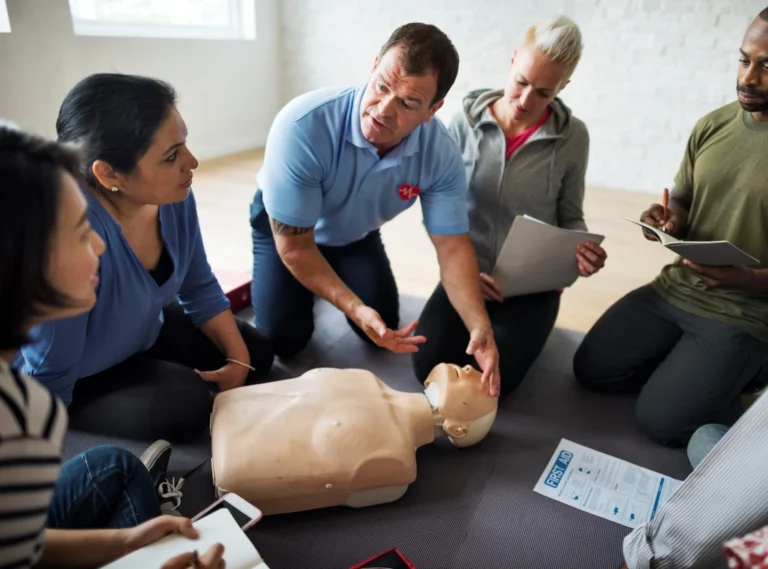
You can understand every slide in a presentation and still freeze when somebody collapses. That is exactly why practical training matters. Learners need to handle the sequence of actions, make decisions, practise the physical techniques and receive feedback.
A useful course should turn theory into actions that feel familiar enough to use under pressure.
There is a common phrase that should immediately make you pause. HSE approved training provider. HSE stopped approving individual First Aid training providers and First Aid qualifications in Great Britain in 2013.
The employer now has responsibility for selecting a competent provider and carrying out suitable due diligence. HSE publishes specific guidance to help businesses make that decision.
The checks should include trainer and assessor competence, quality assurance, syllabus content, training duration, practical assessment and the standards used for current First Aid practice.
Blended learning is accepted by HSE for workplace First Aid when it is used appropriately. It does not remove the need for sufficient face to face teaching and practical assessment where those elements are required.
The most interesting thing about Corby is the mixture. Heavy industry shaped the town, but its future is not limited to one sector. The council identifies Corby as one of North Northamptonshire’s growth towns. New housing, business space and major employment developments are expanding the number and variety of workplaces across the area.
Priors Hall and Weldon Park are not simply housing numbers. They bring schools, nurseries, retail, local services and community facilities. Magna Park represents a different scale of employment around logistics and commercial activity. Corby Enterprise Centre and Corby Innovation Hub support smaller and growing firms.
That mixture is precisely why local First Aid training should be chosen by environment rather than by postcode alone. The phrase First Aid courses Corby covers very different people who may need very different levels of competence.
CPTS delivers First Aid training from its Northamptonshire training centre at Airfield Road, Wellingborough, NN29 7XA. The main First Aid course page also lists Corby among the areas served. For suitable courses and group sizes, training can also be arranged at workplaces.
For an employer, on site delivery can be especially useful when several people need to train together. It can reduce repeated travel, make rota planning easier and allow a group to discuss situations that feel familiar to their own working environment.
The delivery format still has to match the course requirements. Practical First Aid cannot be reduced to theory on a screen when the qualification requires hands on teaching and assessment.
Planning First Aid training for a Corby manufacturing team, warehouse, construction site, office, nursery or public facing business? Call 01234 604 151 or email office@cpts.uk with the number of learners and the type of workplace. We can discuss course choice and available delivery options.
First Aid is useful far beyond the person whose job title includes health and safety. Different courses can suit very different learners.
First Aid works best as part of a wider safety system. If your team operates in construction, industrial or access related work, you may also want to review the following training areas.
Choosing a First Aid course should not feel like decoding a list of nearly identical qualifications. These are the questions that matter most before you book training for yourself or a Corby workplace.
Yes. Employers in Great Britain must provide adequate and appropriate First Aid equipment, facilities and personnel so employees can receive immediate attention if they are injured or become ill at work. The exact arrangements should be based on a First Aid needs assessment.
No. The employer must assess the workplace. Where the assessment shows that a trained first aider is not required, an appointed person must still take charge of First Aid arrangements. Higher risks, larger workforces and other workplace factors can mean trained first aiders are needed.
Emergency First Aid at Work prepares a first aider to give emergency First Aid when somebody is injured or becomes ill at work. First Aid at Work includes the EFAW syllabus and covers a wider range of specific injuries and illnesses. The needs assessment should guide the choice.
There is no single legal ratio that fits every business. HSE says employers should use their First Aid needs assessment. General guidance considers workplace hazard level, workforce size, shifts, absences, separate work areas, remote workers and other practical factors.
Construction is used by HSE as an example of a higher hazard workplace. The exact provision still depends on the needs assessment, but employers should consider the types of serious injury that could occur, site layout, access, workforce size and whether additional training is required.
FAW and EFAW certificates for workplace First Aid purposes last for three years. Employers should arrange suitable requalification before the certificate expires so the workplace does not lose the cover identified by its needs assessment.
Annual refresher training is not a statutory requirement, but HSE strongly recommends it. Regular practice helps trained first aiders maintain basic skills and stay familiar with current procedures during the three year certification period.
Once a workplace First Aid certificate has expired, the person is no longer considered competent to act as a workplace first aider for regulatory purposes. The employer should arrange the appropriate requalification route and ensure adequate cover remains in place.
Workplace First Aid may use blended learning where appropriate, but HSE expects suitable face to face time and practical assessment for the skills that require it. An online theory course on its own does not replace practical competence where practical assessment is required.
There is no general HSE rule requiring every workplace to install an AED. Employers can consider AED provision as part of the First Aid needs assessment. Where one is available, Resuscitation Council UK says anyone can use it by following the device prompts.
If your role involves babies or young children, consider paediatric First Aid rather than relying only on adult workplace training. Registered early years providers in England must follow the current EYFS framework and its specific paediatric First Aid requirements.
Yes. CPTS states that on site First Aid training can be arranged for suitable group bookings. Contact the training team with your location, number of learners and the type of course you are considering so available options can be discussed.
CPTS delivers First Aid training from its training centre at Airfield Road, Wellingborough, NN29 7XA and offers training at other venues. The main First Aid course page includes Corby among the areas served.
Many entry level First Aid courses are suitable for beginners. The important point is to choose training that matches your intended role and, where the course is for work, the level identified by the employer’s First Aid needs assessment.
No. HSE ended its approval of First Aid training providers and qualifications in Great Britain in 2013. Employers are responsible for choosing a competent provider and should check trainer competence, course content, quality assurance and practical assessment.
The price depends on the course, duration, number of learners and delivery arrangement. A short course, a full FAW programme and a private group booking are different forms of training. Contact CPTS for current dates and prices.
Nobody books First Aid training because they are hoping for an emergency. You book it because emergencies are unpredictable and the first few minutes often belong to the people who are already there.
Choose the course for the situation you may realistically face. If you are unsure, ask before you book. A short conversation about the work, the people and the hazards is far more useful than choosing a qualification because its name sounds familiar.
Call CPTS on 01234 604 151 or email office@cpts.uk to ask about First Aid courses for Corby, group training, current availability and the most suitable option for your workplace or role.
We appreciate your message and will respond as soon as possible.