
For Companies: pay only 30% with CITB Employer Network Funding
Enquire nowCoventry knows what it means to build, engineer and reinvent. The city has moved from bicycles and car production into advanced manufacturing, battery technology, future mobility, research, higher education and large scale regeneration. That mix creates opportunity, but it also creates very different workplace risks.
A technician working around production equipment, a construction operative on a city centre development, a warehouse employee, a university laboratory worker and somebody serving customers in a restaurant may all need First Aid. They may not need the same First Aid course.
This is the mistake worth avoiding. Do not begin with the course title. Begin with the workplace, the likely emergency and the person who will have to respond.
Our First Aid courses for Coventry are designed for individuals and employers who want practical competence. The aim is simple. When something goes wrong, somebody should know what to do next.
Need First Aid training for a Coventry workplace or individual learner? Call CPTS on 01234 604 151 or email office@cpts.uk. Tell us what type of work you do, how many people need training and what responsibilities they will have afterwards.
Coventry City Council describes the city as the UK’s leading vehicle design, development and powertrain centre. Around 10 per cent of UK automotive jobs are in Coventry and Warwickshire, while the wider advanced manufacturing sector includes automotive, aerospace, rail, defence and low carbon technologies.
At the same time, the city now has almost 59,000 students across Coventry University and the University of Warwick, a growing professional services sector and major regeneration underway in the centre.
For First Aid planning, this diversity matters more than the city’s reputation. A modern electric vehicle research facility can have a completely different emergency profile from a small office, even though both may look clean, organised and highly controlled.
What could happen in your workplace tomorrow morning? A hand injury? Severe bleeding? Collapse? Burns? A fall? Choking in a restaurant? A cardiac arrest in an office?
Now ask another question. If it happened at the far end of the building, during a late shift or when the usual first aider was off sick, would your current arrangement still work?
That is why HSE requires employers to assess First Aid needs rather than follow one universal ratio. First Aid provision must be adequate and appropriate for the circumstances of the workplace.
A useful way to think about it. The general risk assessment tries to prevent harm. The First Aid needs assessment asks what you will do when prevention has not been enough.
Coventry’s connection with vehicle engineering is not a museum exhibit. It is still part of the working economy. The city and wider Warwickshire area remain a major centre for automotive research, design, engineering and future mobility.
Coventry City Council states that 10 per cent of all UK automotive jobs are in Coventry and Warwickshire. The wider region also contains one of Europe’s strongest automotive research clusters.
Modern manufacturing may be cleaner and more automated than the factory stereotype, but the First Aid questions do not disappear. They become more specific.
Where employees work around machinery, moving equipment, test rigs or production processes, the needs assessment should consider crush injuries, cuts, fractures, eye injuries and severe bleeding.
The correct response may begin with isolation of the hazard before First Aid starts. That is why emergency procedures and First Aid arrangements need to fit together.
HSE updated its L74 guidance in 2024 to give more attention to life threatening bleeding. Where the assessment identifies this as a foreseeable risk, employers should consider additional training and equipment.
Specialist bleeding equipment should follow a recognised risk, not a purchasing trend. Haemostatic dressings, wound packing or tourniquets are only useful when the people expected to use them understand when and how to do so.
One of the most distinctive parts of today’s Coventry economy is battery industrialisation. The UK Battery Industrialisation Centre is located at Rowley Road in Baginton, Coventry. It supports the development and scale up of battery manufacturing technologies.
Around the same part of the city, Greenpower Park is being developed as a major advanced manufacturing and energy site. Coventry City Council lists the project at more than £2.5 billion gross development value, with phased delivery from 2026 onwards.
First Aid training cannot replace a specialist battery emergency procedure. Where a workplace involves electrical, thermal or chemical hazards, general First Aid should sit alongside the site specific controls, emergency response and technical guidance for the process.
The first aider’s role remains immediate care. They still need to protect themselves, recognise serious injury, summon the right help and provide treatment within the scope of their training.
Instead of asking which course is most popular, ask what the learner will be expected to do after training.
EFAW is focused on immediate emergency action. It is commonly used where the employer’s First Aid needs assessment identifies a more limited level of workplace First Aid competence.
Training can include casualty assessment, CPR, AED use, choking, bleeding, shock and care of an unresponsive casualty.
View Emergency First Aid at Work
FAW covers a wider range of workplace injuries and illnesses. It includes the emergency syllabus and adds broader casualty management.
This can suit workplaces where the assessment identifies higher hazards or where a first aider may need to deal with more complex injury and illness before professional help arrives.
Skills that are rarely used become less automatic. That is not a criticism of the first aider. It is normal.
HSE strongly recommends annual refresher training during the three year FAW and EFAW certification period. A refresher gives first aiders another opportunity to practise practical skills and rebuild confidence.
View the First Aid Annual Skills Course
FAW and EFAW workplace certificates are valid for three years. Employers should arrange appropriate retraining before expiry so their planned First Aid cover does not suddenly become invalid.
View First Aid at Work Requalification
Not sure whether your Coventry team needs EFAW, FAW or something more specific? Call 01234 604 151 and describe your workplace, shift pattern and foreseeable risks. It is far easier to choose the right training before you book than correct the wrong choice later.
Coventry’s centre is going through another major physical change. City Centre South is a residential led mixed use development that will deliver more than 1,550 new homes. Its first phase is planned to include 991 homes, 8,000 square metres of commercial space and 17,000 square metres of public open space.
Friargate is another large mixed use development next to Coventry railway station, with offices, homes, retail, leisure and public realm. Construction and fit out activity connected with developments of this scale can continue for years.
Construction sites do not stay the same long enough for a weak First Aid plan to hide. Workforce numbers, access routes, plant, contractors and work areas change as the project changes.
Coventry City Council notes that around 75 per cent of England is within a two hour drive of the city. That central position supports logistics, warehousing and distribution as well as manufacturing supply chains.
Warehouses often create a very practical First Aid challenge. A trained person may be on the premises but still be several minutes away from the casualty.
Distance inside a workplace counts. Large buildings, loading yards, separate units and night shifts can all increase the number of trained people needed to maintain reasonable cover.
Vehicle movements, manual tasks, loading equipment and machinery can also alter the injury profile compared with a small office.
Coventry City Council records nearly 59,000 students across Coventry University and the University of Warwick. Coventry University has a large city centre presence, while the University of Warwick campus sits to the south west of the city.
These environments combine teaching, accommodation, laboratories, workshops, food outlets, events, sports, public spaces and large numbers of staff and students.
A university is not one workplace. A lecture room, engineering laboratory, student residence and commercial kitchen can require very different emergency planning.
For employers and departments within large campuses, the First Aid needs assessment should consider where trained people are located and whether they can realistically reach the casualty.
University Hospitals Coventry and Warwickshire is one of the UK’s largest teaching Trusts and operates major hospital sites in Coventry and Rugby. University Hospital Coventry on Clifford Bridge Road provides a major regional healthcare resource.
Being near a hospital does not remove the employer’s First Aid responsibility. First Aid exists for the period before professional care reaches the casualty.
Those first minutes can feel painfully long. If somebody is unresponsive, bleeding seriously or choking, the useful question is not how close the hospital is. It is whether somebody at the scene can recognise the emergency and act.
Resuscitation Council UK published its latest Adult Basic Life Support guidance in October 2025. The guidance reinforces early recognition, calling 999 promptly, starting compressions quickly and using an AED as soon as it is available.
Adult chest compressions should be delivered at 100 to 120 per minute and to a depth of at least 5 cm but no more than 6 cm. Interruptions should be kept as short as possible.
The guidance also makes an important point for nervous rescuers. Anyone can use an AED. The device gives prompts and tells the rescuer what to do.
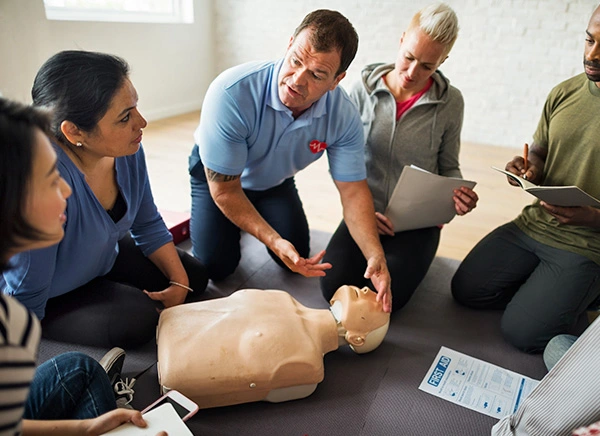
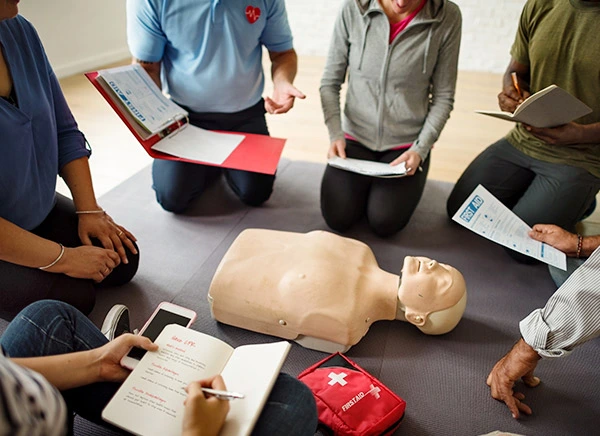
The numbers are easy to remember. The physical skill is not. Learners need to feel the depth, rhythm and recoil of chest compressions. They also need to experience how quickly fatigue develops.
First Aid is learned through doing as well as listening. That is why practical training and assessment matter.
Some employers confuse the appointed person role with being a workplace first aider. They are not the same.
Where the needs assessment shows that a trained first aider is not required, an appointed person can take charge of First Aid arrangements. They may look after equipment and facilities and call the emergency services when necessary.
An appointed person does not automatically become a trained first aider. If the assessment says the workplace needs trained First Aid personnel, the employer still needs appropriately trained people.
View First Aid Appointed Person Training
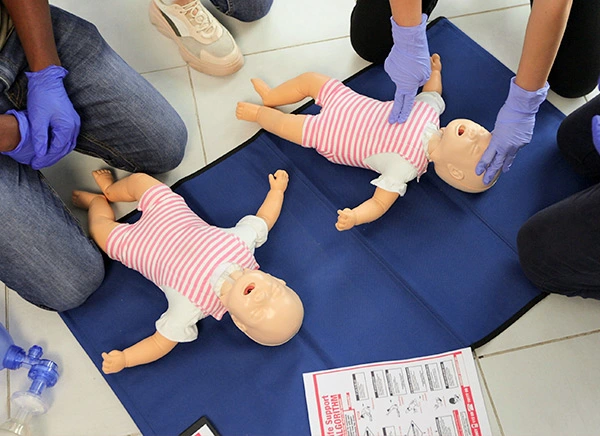
First Aid for babies and young children requires different practical techniques from adult workplace First Aid. Registered early years providers in England must follow the current Early Years Foundation Stage framework.
The current framework came into force on 1 September 2026 and includes specific criteria for effective paediatric First Aid training.
Emergency paediatric First Aid should include at least 6 hours of face to face training. The full paediatric First Aid course should last at least 12 hours excluding breaks, with the emergency elements delivered face to face.
Certificates must be renewed every three years. Childcare providers should always confirm that the course format matches the statutory requirement applying to the setting and role.
View Paediatric First Aid training
City Centre South is not only a housing scheme. It is intended to bring new commercial space, shops, leisure uses and public areas into the centre. Friargate also combines offices, residential, retail, leisure and hospitality.
Public facing businesses need to think about emergencies involving both employees and visitors. HSE’s legal workplace duty focuses on employees, but its guidance strongly recommends considering non employees when planning First Aid provision.
A customer can collapse just as easily as a colleague. Restaurants may also see choking, burns or allergic reactions. Shops and leisure venues can encounter falls, seizures and sudden medical illness.
The practical arrangement should make it obvious who takes charge, how help is called, where equipment is kept and how emergency services reach the casualty.
That phrase sounds authoritative, but it is outdated. HSE stopped approving individual workplace First Aid training providers and qualifications in 2013.
The employer is responsible for selecting a competent training provider. HSE publishes due diligence guidance to help employers make that decision.
Before booking, look for the following.
No. HSE does not prescribe one mandatory list of First Aid box contents for every employer.
A low hazard office, battery engineering facility, construction site and warehouse can reasonably need different equipment. The needs assessment should drive the decision.
Buying more equipment does not automatically improve First Aid. Somebody should know where it is, how to use it and when items need replacing.
There is no general HSE rule requiring every workplace to install an AED. Employers can consider defibrillator provision as part of the First Aid needs assessment.
Where an AED is provided, current Resuscitation Council UK guidance emphasises clear signage, easy access and the fact that anyone can use the device.
CPTS includes Coventry within its regional training coverage. The current Coventry location page lists Airfield Road, Wellingborough, NN29 7XA as the training facility address, so learners should confirm the venue for the specific First Aid course before travelling.
For employers training several people, on site delivery can also be discussed for suitable courses and group sizes. That can make rota planning easier and reduce repeated travel.
For group bookings, send the number of learners, workplace location and course requirement before the date is agreed. That gives the training team enough information to confirm the correct delivery option.
Planning First Aid training for a Coventry manufacturer, automotive business, warehouse, construction project, university team, nursery or city centre employer? Call 01234 604 151 or email office@cpts.uk to discuss course type, group size and delivery options.
The real emergency will not arrive as a multiple choice question. It will be noisy, inconvenient and probably frightening.
If you are planning training for several roles in the same Coventry workforce, these pages can help you compare the available routes.
These questions answer the points Coventry employers and individual learners most often need to understand before they choose workplace First Aid training.
Yes. Employers in Great Britain must provide adequate and appropriate First Aid equipment, facilities and personnel so employees can receive immediate attention if they are injured or become ill at work. The exact provision depends on the First Aid needs assessment.
No. HSE does not impose one universal rule. A smaller lower hazard workplace may only need an appointed person, while another workplace may need EFAW or FAW trained first aiders. The employer decides from the needs assessment.
Emergency First Aid at Work focuses on immediate emergency response. First Aid at Work includes the emergency content and extends training to a wider range of injuries and illnesses. The employer should choose according to the workplace assessment.
The employer should consider machinery, production processes, electrical work, tools, moving equipment, previous accidents, building size and the injuries that may realistically occur. Those findings determine whether EFAW, FAW or additional training is appropriate.
General First Aid training may be only one part of the emergency response. Where battery work creates electrical, thermal or chemical hazards, the employer should also have site specific emergency procedures and specialist controls appropriate to the process.
HSE says employers should consider additional training where the First Aid needs assessment identifies life threatening bleeding as a foreseeable risk. This can be relevant in construction, manufacturing and other work involving machinery or sharp equipment.
Construction sites need suitable First Aid arrangements. HSE uses construction as a higher hazard example in its general guidance. The number and level of trained first aiders still depend on workforce size, work activities and the specific site assessment.
The assessment should consider building size, separate work areas, shift patterns, vehicle movements, loading activities, lone work and how long it would take a trained person to reach the casualty.
Workplace FAW and EFAW certificates are valid for three years. Employers should arrange appropriate retraining before expiry so the planned First Aid cover remains valid.
HSE strongly recommends annual refresher training during the three year certification period. It is not a statutory requirement, but it helps people maintain practical skills that may otherwise be used very rarely.
Not every workplace First Aid qualification is suitable for online theory alone. HSE accepts blended learning where appropriate, but practical skills need suitable face to face teaching and assessment.
No. An appointed person manages First Aid arrangements, equipment and contact with emergency services. They are not automatically a trained first aider and should not replace trained personnel where the needs assessment requires them.
No. The employer still needs adequate and appropriate First Aid provision. The purpose is to give immediate assistance before professional medical care reaches the casualty.
Registered early years providers in England must follow the current EYFS framework. It includes specific criteria for paediatric First Aid training, including duration, face to face emergency elements and three year certificate renewal.
Resuscitation Council UK states that anyone can use an Automated External Defibrillator. The device gives prompts to the rescuer. Training is still valuable because it helps people recognise cardiac arrest and practise the full response.
No. HSE stopped approving individual workplace First Aid training providers and qualifications in 2013. Employers are responsible for choosing a competent provider and carrying out appropriate due diligence.
CPTS offers First Aid training for individuals and can discuss on site delivery for suitable group bookings. Employers should provide the number of learners, workplace location and course requirement so the available option can be confirmed.
The current CPTS Coventry location page lists Airfield Road, Wellingborough, NN29 7XA as the training facility address. Learners should confirm the exact venue for the First Aid course before travelling.
The price depends on the course, duration, number of learners and delivery arrangement. EFAW, FAW, requalification, paediatric training and private group courses are different products, so contact CPTS for current pricing and availability.
Coventry has always been a city where people make things. What has changed is what they make and how they work. Vehicle engineering now sits beside battery technology, future mobility, universities, healthcare, logistics, offices and major city centre regeneration.
That variety is exactly why First Aid training should not be selected by habit. Choose the course that matches the people, workplace, hazards and responsibilities that really exist.
A well chosen course does more than produce a certificate. It reduces the distance between seeing an emergency and doing something useful.
Ready to arrange First Aid training for Coventry? Call CPTS on 01234 604 151 or email office@cpts.uk to discuss current availability, group bookings, on site training and the most suitable First Aid route for your workplace.
We appreciate your message and will respond as soon as possible.